AMORY STARR

  • All
  • Political Economy
  • LuxeWorks
  • Syntax of Power

Anti-convenience

Let’s just be perfectly clear exactly what is going on. I am crossing town, via two buses, in weather below freezing, for a bunch of kale, a chunk of Parmesan, and a bag of flour. While I’m there I’ll have a slice of pizza. Yes, kale is hard to find in Berlin, and it’s unequivocally the best pizza in town, but really? In the last two weeks I have sampled the state of the art in bleeding-edge tech startups, especially in two areas of interest, “DeepTech” (that’s block chain, IoT and other systems which aim to rewrite the DNA of digital world), and “FoodTech”. The reason is because it’s time for me to manifest something and these days manifesting means starting a startup. I attended the Berlin accelerator SmartHectare’s FoodTech meet-up, venture capital firm TechStars’ global episode “startup weekend: Food”, Amatus’ blockchain conference Revision, and the #Tech4Food Summit. To my surprise, the blockchain scene is far more concerned with ethics, significantly better informed about what they are talking about, and serves better food. In four full days hosted by three FoodTech organizations I did not hear pop food icon David Chang’s favorite word one time. Indeed the FoodTech world is

Technology View mid-2018

In 2018 you can build your own website in 5 minutes, with no technical skills. You can edit video in your phone. You can do rudimentary graphic design with Powerpoint. You can run your own advertising campaigns. A slew of professions are kicked to the curb, along with their middle-class incomes and expertise. I use a professional video editing software on my computer, but I would never claim to be a video “editor”. Because I know there are a lot of subtle skills, such as rhythm, and visual storytelling, in which I am ignorant. This doesn’t matter to the next generation of “businesspeople” who have no regard for craft, expertise, experience, or even data. Video editing was a profession. Photography was a profession. Advertising was a profession. Now, the fact that you have a >12megapixel “camera” in your telephone makes you a photographer. The fact that you can add icons to video in your phone, makes you a video producer. The fact that Instagram allows you to upload video to the interweb makes you an advertising agent. Those DIY websites, graphics and videos may not meet the aesthetic standards established by the professional education of their former purveyors, but now

Data Sovereignty Movement

They were wearing [mostly] black. After 10 minutes in the room I asked myself “is this the new left?” I was pretty sure they wouldn’t agree with that term, but they were talking about dignity, privacy, human rights, sovereignty, poverty, democracy, security, marginalised communities, accessibility. The password for the wifi was “itstartshere”. I liked them. They had a lot more skills and a lot less ideology that the Old Left. It was a conference in Berlin called “Privacy for Everyone”, organized by Least Authority and Dekrypt Capital (an investment fund focused on privacy-related enterprises). I had taken it upon myself to become educated about blockchain, but I learned so much more. Privacy One of the strongest concerns of the conference was user data. This could mean anything, so I’m going to distinguish between “lifestyle data” and “digital assets”. In electronic interactions we share extensive lifestyle data about ourselves. Most corporations are now built around profiting from that data, rather than profiting from the services they provide to us. Google and Facebook don’t even charge for those services, and have become so integral to users’ daily lives (and monopolistic) that the lifestyle data they have collected is quite comprehensive (they also have

Syntax of Power

Syntax of Power is a well-tested method for finding Power and Pleasure in every aspect of life. It’s not about politics. It’s about creativity and trust. It includes some memoir, to validate the method. Excerpt Table of Contents

GlasSatisfaction

“I worked as an art director inadvertising for 29 years. First as a consultant and then for more than 10 years in Sennheiser. On my 10 years anniversary, they gave me candlesticks as a present. This was too much. I had saved a lot of holidays, so I used them to go study ice cream in Italy and then I quite and opened Favvo Glass. I used to have sleep problems and pain in my body in my back, arms. Now I’m on my feet all day, but the physical pain is gone.”

John Long

I had written my dissertation about this seeming convergence of movements. Everyone thought I was completely crazy. I didn’t think it would happen so soon. None of us realized in advance what Seattle would be. No one knew we would make history that day. But one my students, John Long, walked into my office and said ‘Dr. Starr, we have to go to Seattle.’ I said ‘I can’t go there! I have to teach classes!’. He said, ‘Dr. STarr, We have to go to Seattle!’  I remember we looked in each other’s eyes, there was long pause, and then I said ‘Ok, I’ll get some school vans.’ ” I have told this story in this way ever since that moment, always with his name. It was such a powerful and for me life-changing moment. I remember it so clearly. (You guys may recall the inside joke in this story which is that after the trip the main issue in the rather short-sighted Fort Collins press who came to my house to interview us was not that we had made history but that we had used university vans for an inappropriate purpose.) I live now in Berlin, I’m retired, and I’m

The body is not a pipe

Nutrition “science” is so unreliable that it can hardly be trusted, and for this reason, I sympathize with people who resign themselves to mystery unaided by modernity. Despite the lack of clear information and uncontradictory advice, we face the choice between [1] believing that what we eat does indeed directly affect our health and [2] seeing the body as a pipe. Many people eat only to quell the annoying hunger pangs or for the taste in the mouth. They presume that their digestive system is nothing more than a pipe between their tongue and their toilet, with a hunger thermostat somewhere in the middle. But apparently the stomach and its processes is so important to our physical and psychological health that it can be described as “a second brain”. There’s interesting research going on, and we’ll see what it tells us to do next. But regardless of whether scientists can tell us anything interesting, I’m curious in where this pipe idea came from in the first place. How did people come to believe that food could only hurt them if it was poisoned, and that it had no healing properties (which remains a woo-woo new-age concept). As my friend Toby

ETH WFS 2016

1. what is economics.
TOOLS
HISTORY
thingsto track
EDGE
how do we find these? history, institutions, ideology

Farm Tour with Martin Ott

As part of the ETH World Food Systems Summer School 2016 I had the honor of 3 hours tour of the Fintan farm and Sativa Seed Production facility with farmer Martin Ott. Fintan is the largest organic farm in Switzerland, a country whose organic agriculture regulations forbid heating greenhouses. We had a chance to hear about 5 aspects of the farm. Own sorts Our first stop was at a small field which is devoted to the project of de-hybridizing sweet corn. The field includes all 160 varieties of sweet corn. In this field Martin is allowing the hybrids to re-breed, creating diversity again. He sees this as a necessary process which must be repeated with every plant in every place to develop seeds that are most appropriate to each ecology (“own sorts”. Fintan is doing this for 1200 different plants. The wrong varieties cannot feed the world. He also explained that corn plants produce 89km per day of hair-roots covered with neurotransmitters that cannot be exactly distinguished from the soil itself. This is where the plant “speaks” with the soil, the microclimate, and the human culture which affects it, making decisions about what to do. He referred to this as one of many

Symbols and certification schemes

I’m hanging out with my friend Aimée Schreck at the ETH World Food Systems Summer School, discussing symbols and certification schemes for packaged food. Her dissertation examined small-scale banana producers’ experience of the fair trade system. Together we decided some years ago that fair trade was best understood as a gateway drug and that really the consumers ought to be certified, not just the producers. There are several definitional dimensions, which are rarely synonymous: social movement attempts to create social transformation and ethics organizational attempts to put social movement ethics into practice through independent certification laws and regulations (usually implemented once corporations want to enter the market) associational symbols displayed voluntarily Some categorical examples of what may be indicated: organic/bio, biodynamic, sustainable fair trade local or national production, country of origin designation small-batch, fait maison, slow food appellation d’origine contrôlée, denominazione di origine controllata non-GMO, paraben-free … Some implementation challenges: transparency accountability verification trust An example of the resulting complexity is that fair trade was developed by Global North allies to support Global South peasant producers. But the certification agencies develop an interest in institutional maintenance and development. Like any middle-men they are easily able to take advantage of their position.

Creating New Food Systems ETH WFS 2015

So the topic of this session is innovation and social change in the food system.  I’m going to start with some examples of innovation. There are too many to cover in such a short time, so I only choose some examples. Then I’ll share some conceptual tools for thinking about how to create powerful social change.  The capital letters indicate when to move forward in the prezi.   Innovations FMKT Farmers markets are certainly not an innovation, but their rediscovery is. Their primary function is direct exchange between farmers and eaters, but they serve many other functions as well. They are now a destination for foodies, families, people concerned with nutrition, and a place to have breakfast. They introduce people to new foods, teach about ecology through seasonality, about cooking through conversations, and most importantly, about relationships. They are friendly instead of alienated, people talk to strangers. They go beyond competition. In the US, farmers markets had declined so that in 1994, there were less than 2000 markets in the whole country. Now there are nearly 8500. In California in 1970 there were no farmers markets. A social movement started and there were 7 markets by 1977, 52 in 1981, and 729

New heroes … New masculinities …

A few days ago I was sitting at Maso A Kobliha in Prague (at the recommendation of the excellent Taste of Prague Blog), savoring a plate of superlative house-smoked meat, three donuts, and tea. By way of entertaining my vegetarian and already sugar-shocked friend, I told him about the return of butchery, a new generation, typified in The Real Meat Society, mothership of Maso A Kobliha, sister of Sansho Restaurant. (If you aren’t familiar with the revival of artisan butchery, watch this video:) And then, inspired by the teacups sliding around on dessert plates rather than held static in a saucer, delirious from the first donut, and very glad I didn’t have to share the meat, I just kept talking. Freestyle rapper Supernatural says the voice is its own intelligence, no mere derivative of the brain. Here we go… “It’s a new heroism, educating people to eat the whole animal, paying the farmers fairly, supporting ecological farming…” So far he understood. I stopped talking. Stared right past the second donut. I haven’t properly written about it, but I tweeted that whistleblowing is a new archetype of heroic masculinity. It’s all that solitude, self-sacrifice, and moral righteousness, but without muscles. Butchery, on

“Many fights, and many kisses” lifetime tables by MBzwo

“We try to keep the distance between the customer and the workshop as short as possible…These are objects that I want to be used. And it should be used hard. That’s what they’re made for…Buying a table takes a long time. It takes months….Most of these people are buying the last table for their life…For me it would be a success if the grandchildren still like the table.

The Future should be Durable

Interview with Stefan Schridde, founder of the Murks Center against planned obsolescence. Murks means “botch”, or “bad work”. “Products designed with planned obsolescence don’t meet the needs of the society.” He sees cheap consumer goods as “lonely” and the alternative is a “durable” future.

Zagreus art/dinner

Dinner at Zagreus. Best €36 I’ve ever spent. Every bite was so delightful. Zagreus is an art gallery owned by a chef. Every exhibit inspires a meal, collaboratively co-designed with the artist. This time, the show was by a group of students in product design. The table, napkin, lighting, and servingware for each course were designed by different groups and Chef Ulrich Krauss invented fabulous flavors for each aesthetic experience. The serviceware was so compelling that it kept the focus on the experience of eating.

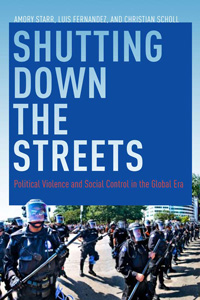
Introduction to Street Protest, Blockupy Workshop in preparation for Frankfurt ECB 2015

1. Why Street Protest
• a fundamental right and contribution to democracy is to express our dissent
• collective manifestation of dissent creates news, encourages others, threatens elites
• the way to win (reforms) is to raise the costs of the current way of doing things until it becomes in the interests of the elites to do it our way
• threat/promise to take over

Why are the San Francisco street protests so robust? Interview with San Francisco Magazine

Historical evidence insists that oppression on its own does not produce social movement reaction. In places with little culture of resistance, there will be little social movement reaction to social problems, or occasional outbursts may not be sustained. San Francisco has had, regularly and recently over the last decades, a series of effective and sustained street manifestations, so there are people, organizations, networks, systems, etc. to make the next ones bigger and more robust.

The Grounds (groundless) Sydney, review

If Disneyland had a farm (and they probably do}  it would be The Grounds.  It’s farm aesthetic as money machine.  And swarming with spenders sucked in by the latest gimmick,  an urban farm. It’s definitely got a lot of landscaping.  Mostly flowers.  The kale has gone to seed and the vegetable area does not appear to be tended or harvested.  Certainly the planting is not organized to maximise on-site food production. There are farm animals.  An adult pig,  three adult goats,  and two very pretty white chickens sharing a space the size of my perfectly normal bedroom.  My ecologist friend DS thinks it’s pretty radical to make folks look at a cute chicken or pig before ordering one. There is a market feel,  with various items sold from portable wooden carts.  However there’s nothing seasonal about what’s being sold,  and no educative role for the vendors. Of course just like Disneyland,  all the cash collected in diverse locations funnels into one pocket. I’ve never before been tempted to describe a food experience as “feel-good”  but that is definitely all that’s happening here. Also evocative of Disneyland is the serious innovative proliferation of entertaining stands (lemonade, pizza, sausages, donuts, smoothies… ) Lots

Lech Wałȩsa and craft labor

His explanation of his strategic capacities is “I am an electrician.” This reminds me of Matthew Crawford’s painstaking work on the “cognitive riches” of trade labour. (Summary here.) Crawford’s point is that trade work is satisfying. Wałȩsa’s point is that it is also a form of analytic training.

Mehl Stübchen Berlin

The Mehl Stübchen is a flour factory which creates flours for many specific uses. They sell to home bakers, rather than to businesses, providing advice and information to improve the quality of home baking. They also sell very good bread and pastries. They are located in the “Red Island” of Berlin at Leberstraße 28. The owner, Nicole, needed me to bring a translator for the interview, so thank you to Julie August for the assistance. “Why are you doing this?” “There’s an increasing number of people who want to bake themselves, but ther’s a very limited choice of flour in the supermarket. Even in the bio (organic) market, you can’t get much choice. Maybe a little more, but you can’t learn which one to use. We produce, sell, and teach people what to try.” “Why were you personally drawn to do this?” “It was not my original profession. I was working in a dentist’s office. Then for some time I didn’t find employment and I was wondering what to do. One friend was interested in starting this business, and we did it together, but now I own it alone.” “Why do people come?” “People appreciate that I can consult with

The Home Project, Berlin

Walking through Kreutzberg/Neukölin I was drawn to another minimalist window display of an unlit store in a residential street. Like most entrepreneurs of shops with obtuse names in quiet streets, the owner wasn’t all that interested in promotion. The Home Project is a project of two designers, Álbio Nascimento and Kathi Stertzig. “I’m interested in your project”. “Good.” “So?” She seemed comfortable with monosyllables, just my style, as I fumbled for a pen: “Why?” “Because we want to work with artisans. We’re designers. We like to have a process with them, starting from what they do. Each one has a handwriting. But they also have limitations, the way they were trained, usually just one material.” They work mostly with Portuguese artisans, as Nascimento is Portuguese, but also with Greek and others. “And second, for regional development, regional culture.” “Why do people buy from you?” “The story.” “How’s it going?” “Well we can’t make a living from the things. The consultancy for regional development is how we make our living.” “But is it growing?” “Yes, we can feel that.”

Sunshine, my beloved

There’s a tiny chill in the air in Neukölln  where my friend deposits me for the best burger in Berlin, Schillerburger.  I can’t get past the sweet potato fries then I walk toward a  community garden “on the old airfield”, stopping for the best vanilla ice cream cone to date, at Mos Eisley. Amidst runways and grass is indeed a community garden, full of container plants,  bikes, and handmade benches,  all climbing or reclining toward the sun.  It’s cool with out being shaded,  it smells wonderful.  A few beer bottles.  And people,  everywhere. Because there’s grass. And no fences.  

Helmut Menzel porcelain at the Berlin Make Markt

I was going in a different direction, on an arbitrary itinerary when I saw a poster for the Berlin Make Mrkt and figured out that it was monthly and this afternoon, the first Sunday of the month in Prenzlaurberg. The market was quite small, and typical of Australian and US markets in mainly offering jewelery. There was a knifemaker, several furniture resurrecters, and some knitted lampshades. I engaged in my usual behavior of buying rings in Berlin that are too big because it’s hot and my hands are swollen. I knew I was doing it. Then I bought M an espresso cup from Helmut Menzel. The cup is porcelain, cut with a knife. Helmut  learned ceramics from his parents, then went to art school and worked for an artist. “I couldn’t keep my hands off this profession. I have too many ideas.” He doesn’t have a website. htmzl@gmx.de or 0177 648 72 12. He explained that he doesn’t try to create something that will sell. “I make what I like.” He sells at the Berlin artisan market and at some annual artisan markets. “I don’t like selling with shops. First, they take 40% of the money. But also I need

Prinzessinnengarten

My favourite reading is food blogs and my favourite Berlin food blog is Stil in Berlin.  The author gets around,  and reviewed the food in the community garden, Prinzessinnengarten.  I thought it was clever to serve some food in a garden so went for a visit,  but found a lot more than I anticipated. The main difference between this garden and every other garden I’ve seen is that it’s full of people.  The first reaction I had was a very emotional resonance.  The social energy on the site triggered memories of the struggling to save the South Central Farm,  when we were just putting bodies there as much as possible. The central area of the garden is a picnic forest.  Saplings and tables offer a spacious and tranquil environment for intimate chats,  study,  and groups.  Food trucks and sheds circle the tables,  serving espresso,  meals,  and beer. The outer ring of the garden houses a series of centres.  About half of the circle is garden proper,  with all the very healthy and productive plants growing in containers. The other centres are materials storage,  an upcycling workshop centre,  gardening education with starts for sale and books to read,  and construction areas.  Two

Markthalle Neun

In a less gentrified yet part of Kreutzberg is this market described by my favourite local food blogger as “the most interesting food in Berlin”. The large covered hall hosts an artisan food market several days a week every Thursday there’s a “night street food market”  which is a food truck scene without the trucks,  each stand vetted for interest and quality. Unlike many other informal gourmet scenes,  this one offered more product range with the mozzarella and truffle stands both offering “shots” (one bite,  served in a shot glass) for 2€ as well as small plates (máx 5€). There was American barbecue,  arepas, waffles.  The emphasis was on fresh preparation,  so was assembled after the order placed.  The mozzarella fit told me the provenance of the converged and the salt as he dressed my caprese salad.  Fish was smoked on premises,  and a whole pig had been barbecued  (and sold out in about an hour.  Beautiful focaccia (including a sweet version) was baking. Delicious,  but what was extra  interesting was the space-making,  destination-making.  When I arrived at opening time 1700 it was possible to walk around looking at the stalls.  But 1730 all the picnic tables were occupied,  and

Kochhaus

Four years ago I met a guy in Paris who was delivering measured ingredients for 3 meals for 2 persons once a week. “Because people feel guilty that they don’t cook for their families.” “And that they have such beautiful kitchens that they never use.” I bought the domain feastbox.com.au. Had a few twists of my own in mind, but wasn’t quite ready to take the plunge into a food business. In June, Hello Fresh, a startup doing the same thing (except not organic, local, or artisan) got $50M in startup funds in the U.S. In Berlin I found the German Kochhaus chain, which does it differently. The store is full of wooden tables, each one presenting the ingredients for a dish, labelled with price per person. You buy the recipe for .50 and then collect the pre-measured ingredients for the right number of people. The meat is from local farms (I didn’t ask about the rest). You could be in and out of the store in 5 minutes if you want, or you can browse cookbooks, cooking equipment, or assemble your own meal with tidbits from various tables. The key is getting people to cook again so they will care

Leather Workshop, Dresden

The Neustadt neighborhood of Dresden, which was rebuilt by artists after the reunification of Germany, has quite a few artisan manufacturers, including shoes and clothes designers with the sewing machines right in the shop. I was intrigued by Susanne Möller’s Leather workshop at Alaunstrasse 70 (open Monday to Friday from 1400-1800) Phone 0173 56 11 912. The main products on display were colorful leather children’s shoes. She also made a very dramatic folded handbag and other accessories. She refused to be interviewed or photographed until I returned with the charming Andreas. “Why are you doing this?” She makes the international sign for money, rubbing her thumb and forefinger together. “Is that the only motivation?” “It’s fun, and I can.” “How did you start?” “I began as a teenager to handmake clothes, because in East German there were no shops. You had to make something interesting yourself. So I began with normal clothes now for 15 years I work with leather.” She loves her job, explained Andreas. “Why do people come?” “The quality. Everything is unique and the size is customized.” “Do you sell to tourists?” “Only a few. Most are locals who know about the shop and return. It’s a

Apfelgalerie Berlin

“Usually we are cheaper than the discounters, because there’s no middleman.”

Winterfeldt Market Berlin

This market was so movingly delicious to eye and sense, that I had to just enjoy it rather than documenting it. Produce, baked goods, prepared foods, and hard goods stalls were mixed and profuse, which was delightful. It’s summer, so the market was full of berries and cherries. Although I have so far not found Berliners to be nice to strangers, that was not the experience in this market, and, also interesting, this seems to be typical of farmers markets everywhere I go. Many of the produce vendors were resellers, but many of the hard goods were local objects. I finally got new business cards, by letterpress, at the farmers market. (Video coming.)  Local food, local business cards… So despite being hesitant and apologetic every time I needed to speak, because I do not have any German at all, I felt at home with the friendly and happy attitudes of the vendors.

“To hell with the market” …. visit to my hero F.E. Trainer’s sustainable world

“Composting and growing carrots is a nice start, but we need to get rid of the growth economy, make the global economic system work to meet needs, and replace capitalism with a different economic system that works for people. Most Green people are stuck at the level of compost heaps, which don’t have a chance of saving us. We don’t want to be a society full of compost heaps heading for disaster. Growing carrots locally is just the first step to changing the economy.”

Andrew Calabrese on food and media justice

Andrew’s comparison of the global consolidation of media with the global consolidation of food, gave me an idea! I’ve been applying the model of the local food movement to local objects. What about applying the model of the local food movement to recovering the media! Just as we’ve learned to buy direct from farmers, we need to figure out how to deliver our money directly to journalists. As food activists have innovated new economic institutions to facilitate getting consumer money to farmers, appropriate new economic gadgets are needed to support journalists. And just as farmers need us to invest in the crops in advance through mechanisms like CSAs, investigative journalists need us to invest in them for months before we receive the harvest of hard-won news.  Farmers care for our food. Journalists care for our democracy.  

Alana Mann Power Shift

My words at launch of Alana Mann’s Power Shift

Alana has studied one of the many vibrant alternatives to this juggernaut, the movement for food sovereignty, conceived and led by La Vía Campesina. Vía Campesina is typical of contemporary social movements in its recognition of the common interests of first and third world farmers, smallholders and laborers, producers and consumers and in its recognition of the centrality of women, indigenous people and culture to forming truly liberatory alternatives.

heartbroken consumer

Today my beloved MacBook Pro fried its logic board…Why is there so much consumer choice but not what I want?…But my real question is why aren’t companies somebody refurbishing the beautiful, solid old hardware chasses of these classic designs. Convert those BMWs and Mercedes to electric systems? Design lightweight guts for those beautiful PowerBooks and Communicators. If corporate design can’t match vintage classics, then innovative small companies should be designing custom kits to keep these beauties on the road.

the crisis has no clothes

As a budding Australian, I learned this week that right-wierdo Tony Abbott’s budget cuts are spurious. The agenda of the cuts is to eliminate the deficit, but it’s not a big deficit and it’s not particularly a problem. Having invented a problem, Abbott has cut “across the board”, implementing Australia’s first user fees for healthcare (including children’s immunizations!) and cuts to profitable investments in innovative enterprise. During the same week, I was lucky to attend a fabulous seminar by Jim Stanford, Economist for Unifor, Canada’s largest private sector trade union. He explained the financialization of Air Canada. Financialization is the process of treating a non-financial company in financial terms. Basically liquidating its assets without regard to its reputation, and continued ability to operate. Air Canada’s own internal services were sold off as separate companies, from which Air Canada now has to buy essential services (such as airplane maintenance). Billions of dollars were made on these sales. Financialization is a finite process. Once value had been stripped from the company, the investors abandoned it. Air Canada is rebuilding, but without cash reserves and resiliency. Indeed $6 billion was siphoned from a company that had basically not made a profit for about 25

health: the new prison

The prison industrial complex is based on the insight that bodies can be made profitable without their consent. You just need the right regulatory framework. Governments come in handy for corporate schemes. Nutritionists’ longstanding warnings that processed food is unhealthy are beginning to materialize as public health crises. The U.N. Special Rapporteur on Food announced this week that “unhealthy diets are now a greater threat to global health than tobacco.” The carcinogenic tendencies of agricultural chemicals have long been apparent. Corporations are pushing this food not only with advertising, but with retail strategies and Free Trade policy, which both secures market access, and reduces regulations on toxic agricultural and food inputs. If they succeed in making more people chronically ill, pharmaceutical dependence could become a new prison. Our very bodies involuntarily become a source of profit. This has been the trick lately. It’s called commodification. Marx carefully analyzed the significance of the shift from barter (in which both trading parties have an interest in the usefulness of the goods being traded) to a system of trade in which investors see goods only in terms of their exchange-value (how much margin can be made by buying low and selling high. It’s