AMORY STARR

  • All
  • Political Economy
  • LuxeWorks
  • Syntax of Power

of meat and videogames

Both vertical and horizontal integration being tedious, the new business model is getting out of the business of making things and into the business of control. So many people are already good at running little sweatshops and raising cattle, why bother? To capture the profit in the beef industry, you don’t need to actually raise animals. Indeed you don’t even need to sell them. The key is to seize control over killing and chopping up cows. Implement a bit of horizontal integration by purchasing the largest facilities and driving all the small ones out of business. For the latter, the key is to influence the law to increase the costs of regulatory compliance. If only your facilities meet requirements, you don’t actually have to triumph through the ordinary process of competition. Once you have a chokehold over a key part of the commodity chain, you can dictate financial terms to the parties on either side. Tell farmers what you’ll pay for cattle, and tell retailers the price of beef. You keep the fat. A similar model enabled fashion brands to avoid liability for working conditions. Thousands of tiny sweatshops could compete for contracts. None of the risk or moral responsibility came


The Impetus for and Viability of Local Food Systems

This is my second project for the Australian Food Sovereignty Alliance, with whom I’m just thrilled to be working. The piece is co-authored with Nick Rose, as a follow-up and expansion to a piece he wrote to introduce to Australians a policy instrument, the Local Food Act, which has been implemented recently in Ontario Canada. The original article was in The Conversation. Because of its popularity and attraction of a lively debate, we decided to provide more food for thought and action. Our paper, “A Local Food Act for Australia – the Conversation continues: The Impetus for and Viability of Local Food Systems“, covers these points: What’s wrong with the dominant agricultural paradigm? What suggests that local food systems constitute a viable and desirable alternative? (here we discuss consumer interest and farm profitability, as well as some innovative institutions: local branding schemes, farm-to-school, food hubs, and urban agriculture) What is needed to develop local food systems? (here we discuss food policy councils, agro-ecology, peri-urban agriculture, the health connection, Local Food Acts, and Fair Trade Agreements)    

I want a Lab

LAB lab A Lab for Interventions, Innovations, Iterations to facilitate: Local Food, Objects, and Quality of Life – Artisan Economics and Meaningful Work – Biospheric ecological technologies and institutions. As Robert Pekins of Food Connect said to me “Academics need to get right out of the way. What they’re good at is asking questions. We need fora with practitioners in the audience practitioners doing the speaking, and academics asking the questions.

Local Food Analytic Maps (US and AU)

The first map is a graphic representation of my analysis of the US movement, and the other denotes the comparable elements existing in AU (to my very limited knowledge).

RootStock: natural wine pairing for local food movement

“People see eggs and they ask ‘are these barn raised or free range raised?’ ‘Are they organic or not?’ It baffles me that wine is not the same. Where did it come from? How was it grown? Is it organic? People should be interested in the process and provenance of wine, the same way they are with food.”

About [high] fashion

I’ve never written, or even articulated, anything about fashion before. But we just saw Mademoiselle C, which displays the eccentricity and waste of high fashion both honestly and sympathetically. And in the conversation afterward I found myself articulating a stronger, more coherent, and more pro-fashion viewpoint than I knew I had. Fashion serves four purposes Clothing Seduction Ritual/incarnation (choice of clothing to maximize your power in a given context) Expression I am concerned here with the fourth. I believe that creativity and art are one of the worthwhile aspects of spending time as a human, one of the things (along with, so I’ve heard, parenting) that makes people feel fully human, fully alive, and complexly whole. Too few of us have access to artistic training, materials, time and the various kinds of space you need to be an artist. And yet we all have not only the capacity but the need for expression. Fashion provides most people with a daily medium for expression, and therefore, I would argue, is a form of popular, populist, and participative art. The role of high fashion –by which I mean both couture fashion design and, perhaps more powerfully, fantasy/extreme fashion spreads conceived by stylists

25 ways to spend $25M on a secure future for Goulburn farmers instead of giving it to Coca-Cola Shepparton

Australia’s state government of Victoria has pledged $25 million in subsidy to Coca-Cola/Amatil to keep the SPC/Ardona produce cannery open in Shepparton. The federal government refused to match the funds to meet Coca-Cola’s demands. But even if the factory stay open for another period, with the farmers dependent on short-term contracts from the factory, their farms are insecure and their future precarious. Without domestic production, Australians become dependent on imported produce and global market prices. Here are 25 ways the state government could spend that money which would contribute to the long-term security of farmers, farmland, domestic food supply, and distributed infrastructure. Provide education, training, and financial resources to help farmers convert to sustainable agriculture so they can offer a superior product to Australian consumers while protecting the ecosystem and reducing greenhouse gasses caused by petrochemical production and fossil-fuel based agriculture. Fund regional ecological agriculture extension agents, facilities, collaborations between universities and farmers. Help farmers diversify their production, which protects soil, insulates from pests, and decreases farmers’ dependency on single buyers. Help farmers set up regional Community Supported Agriculture programs to enable consumers to have direct relationships with farms. Educate consumers about the superior healthfulness and flavor of fresh, ripe foods

David Flinter’s Permaculture Macadamias

I first visited this farm when I was 19 in 1979. Shortly thereafter my friend who owned the farm was killed in a car accident. The parents offered me the chance to buy the property and I jumped at the chance. The farm was back blocks of the conventional farming area, and it was considered scrub country. It wasn’t valued for any purpose, because it was too steep for cattle and totally vegetated. I jumped at the opportunity because to me it had value. I finished my horticulture degree, left Sydney and my girlfriend, and moved to the land. I lived in a tent for a year. Then I went back to the city to earn money to invest in the farm. At this point I met Kerrie, my future wife. We used to drive up on Friday night after work, which took 7 hours before the highway was built. We drove up the old pacific highway. No one had ever lived there. We were the first to live on this farm. We’d spend the weekend, just experiencing the land. We made the commitment to move to the land in 1981 with a tent and a suitcase. We lived in

DIY Economics

Gold bugs, income-tax-is-illegalists, illuminati cogniscentis, federal reserve suspicionists … get a bad rap from the left, who rebuke these analyses as “conspiracy theory”. We are part of an under- or de-educated population, who are -thankfully- waking up from an enchanted nap of patriotism to bravely question a country that daily betrays its promises of democracy and egalitarianism. They are teaching themselves economics and history. Those of us with the privilege of education should applaud and encourage the efforts of these street scholars and lay economists.  We should recognize and support these communities of self-trained researchers and teachers, seeing their projects as works-in-progress and contributing encouragement and tools to them to continue and expand their research.

Of sushi and fur

Since consumption is one of the major places we express our values and try to make a difference in the world, conversations about ethics and sustainability are increasingly happening in the form of questions like “do you wear fur?” As it turns out, I own quite a lot of fur. Most of it was dead before I was born, passed down from grandmother or mom.  I believe in taking care of fine materials and fine craftsmanship, so I just enjoy and care for it. Would I buy new fur? I balk, but I’m not sure of the foundations. Is it different from meat? I eat meat because in my understanding it is impossible to have an ecologically or economically sustainable farm without animals. “If it doesn’t walk off the farm, you’re selling your soil.” Can’t have animals around for fertilizer without eating them. (Most farms aren’t organized this way now. Instead of sustainable farms, we have unsustainable livestock facilities and unsustainable monocrops dependent on petrochemical fertilizers, but if we reorganized everything properly the animals would provide the fertilizer for the vegetables and grains.) Fur is basically leather. In Argentina, the leather industry is a by-product of the meat industry. That seems

Googlemaps make me feel stupid and sad

Ok, so we’re cyborgs now. This means that we will start to notice performance differences among us which are based on purchased augmentations. If you have one of the latest smartphones, you not only don’t need to remember telephone numbers, you don’t need to plan anything in advance. The phone knows where you are. It knows the places you go to often and it will let you know how to get there by various means and how long that will take. If you want to visit someplace you haven’t been to before, no need to look up the address at home and write it on a scrap of paper, because your phone will be able to look up the address for you, as well as providing transportation guidance. You don’t need to know your city’s streets and neighborhoods, your transportation system, or distances, because your phone will provide step-by-step instructions  by voice or print for getting from here to there with whatever transport options you have at your disposal. Your phone knows about one-way streets, traffic, and train delays. If you make a mistake it will automatically re-route you. What this means is that navigation, estimation, and knowledge of place

John Talbot Woodworks (and Poetry)

I was a contractor. I bought a hobby lathe on sale. I burned out the motor in 6 months, so I knew I had found my calling. I call it “reclaiming the souls of trees”. In Los Angeles there are trees from all over the world planted in backyards and sidewalks. There are 400 year old oaks that were here before there were towns with Spanish names in California. If the trees get sick or the roots interfere with buildings, they are cut down. I intercept trucks carrying pieces of felled trees and his friends tip me off when a tree is to be cut. Once I watched the bees return to the empty space where their hive had been. When crafting a bowl, it’s really moving to know that there’s a landscape locked therein. What better way to honor the life and death of a tree than to turn part of it into a beautiful and useful object? Such objects share secrets of the tree’s life: its orderly annual rings tell its age and chronicle drought years and show scars and stains. A humble sometimes very long life is there to be shared. Trees grow up and down at the same time, like our waking

Maaike Furniture Resurrection

This piece was a curbside find from the South Coast. My sister has developed a habit of txting me when she sees things. It was beautiful but it was very old and had obviously been damp. It’s probably the first piece that I stripped right back to the frame and then built up. A lot of time I try to manipulate what’s already there and bolster it.   There’s a handwritten mark in there from the person who upholstered it before, their name and the date. I think it was in the 60s that it was last done. So I wrote my name and date in there, which was the first time I did that. It’s chair archeology. I always find something cool in every piece, a religious token or a penny, half a deck of poker cards, a guitar pick. In this one I found a name and a date. The chair had a really cool stuffing line across the back and I really liked it…I started out with her original line and took it higher and made it asymmetrical. So it starts where it always started and ends somewhere new.   I bought a panel of printed “Tree

Wendy Neale on Sustainable Furniture

At the centre of my design interventions is the idea of working in the margins, on the edge, in the spaces between. “Embodiment” refers to the tension and struggle between a world in which what is valued is increasingly digital, distant, and idealized and a world of everyday relationships, sensations, and mystery. I have lived in the interstices, gleaning, struggling for meaning between street protests and my job in an ad agency, building furniture while working in refuges where it always seems the world is falling apart. When I was first becoming an artist/designer, I didn’t gave any thought to where I’d get my materials. I went directly to the piles of stuff left behind by other students in the workshops, finding abundant treasure just as I had done as a young traveler. When I work with discarded materials I bring the sensitivity I learned through years of working with women and children in crisis. I am committed to the objects’ integrity and new life. Throughout the process, I find myself in relationships with people who attach sensations and stories of their own. It is not a conceptual design process. We stop for coffee and a smoke. It’s a slow

Lessons of the Local Food Movement at Vivid Sydney

I was invited to speak at Design your Day Job, organized by &Company, part of Vivid Ideas 2013. 25 May 2013 Sydney Australia I’m new to Australia, and since I arrived, I’ve really hoped to become part of something like this event, so I’m absolutely thrilled to be here with you today. Although I imagined we’d all be around a long table and I’d be cooking for you. But this is cool too. My talk today is somewhat biographic. Because when I sat down to write it I realized that I needed to remind myself why I’m doing this, where did it come from? What are the goals and principles? Before I start I do want to say that I’m quite sure that Powerpoint rots the brain. So the talk is a bit clunky. The story starts when I found myself in a masters of city planning degree, surrounded by activists. They were primarily people of color and some white people working for social justice. At that moment in that place the important issue seemed to be about knowledge. So- called “experts” were imposing solutions on these communities which didn’t work. And the communities had their own ideas about what liberation

Spatiality and consumership

Exploring Melbourne, we chanced upon a parking lot transformed.   The People’s Market in Collingwood opened this December at 64 – 68  Stanley Street as a Thursday-Sunday destination with food, coffee, alcohol, art galleries, pop-up retail, and live music (even a “band in residence”). Many other public spaces could fit this description, but there was something special about this one, and we sat there looking at it and feeling it and trying to figure out what made it so different. Yes, we were there are consumers, buying coffee and food, but it felt like so much more. Well, Nick said, “those chairs are not going to be at some wedding reception across town next weekend.” The chairs were made alternately of empty beer kegs and double-stacked milk crates, topped with an astroturf “cushion”. Astroturf was in use liberally, to remarkably greening effect. What was it we were sitting on? We had clambered up a pyramid of sorts, a set of uneven risers, made of plywood, painted black, and irresistably requiring four-limb climbing rather than mere stepping up. From here we munched on “vegan soulfood” and overlooked a beer garden of sawhorse tables, beerkeg chairs, and awning, a collection of shipping containers hosting the

The cognitive riches of artisanship and craft labor

Matthew B. Crawford, Shop Class as Soulcraft: An Inquiry into the Value of Work. 2009: Penguin Books. If the regard that many people now have for the wider ramifications of their food choices could be brought to our relationships to our own automobiles, it could sustain pockets of mindful labor… [102] This is the book I wanted to write, to try to get at the fulfilments of artisanship, and what this suggests for how we should organize the economy. I am thrilled that Crawford has already done it, and so well. My own experience –and what I keep hearing from artisans I talk to– is beautifully captured in the introduction: As a motorcycle mechanic…The wad of cash in my pants feels different…as executive director of a Washington “think tank” I was always tired…This sense of uselessness was dispiriting…I offer my own story here not because I think it is extraordinary, but rather because I suspect it is fairly common. I want to do justice to intitutions that many people have, but which enjoy little public credit. This book grows out of an attempt to understand the greater sense of agency and competence I have always felt doing manual work, compared

Manufacturing consent

Noam Chomsky is perhaps best known for the book he wrote with Edward Herman, Manufacturing Consent, also made into a wonderful film. They show how the mainstream media is used to manufacture political consent in purported democracies. I’m interested in how consent is manufactured to other kinds of changes in our worlds. For example, biotechnology crops have been so widely introduced and with so little oversight, that we now hear that we are eating biotech food, without having consented to it. Organic corn has been contaminated. When the alternative has been destroyed, or is hard to find, “consumer choice” is a sham. Since it is a done deal, our deliberation and consent are made meaningless. Airports are an interesting site for manufacturing consent to new technologies. Since we have already purchased a ticket and made plans to arrive somewhere, we find ourselves willing to submit to invasive security procedures that, would we consider them from the vantage of home, we might not accept at all.  Introducing retinal scans and other biometrics as a hurdle to a desire we have already committed to elides our considered judgment. Having submitted biometrics once, it’s a done deal. There is no point trying to

what is the academy for?

I’ve been a great defender of the academy as “a living archive” of ideas, some of which were supposed to have gone away due to unpopularity…Ideas kept alive and lively by impassioned scholars who can impart detail and vividness to the next generation. But I’ve also always suspected, and now want to insist, that it is also a form of social control. Suck in “the best and brightest”, absorb whatever privilege has caused them to spark, train them to a dizzying level from which they can barely communicate with the rest of society, and then lead them down a path very surely designed to keep them powerless. It’s that last bit that’s the kicker. I’ve come to understand that the best and cheapest social control takes the form of psych-ops. Indeed much of the use of force is ultimately psych-ops, exerting an indirect effect on the courage of observers. It’s also harder to trace, and organize against. It seems more humane than force. It is the method of purportedly democratic societies for controlling their populations without appearing to censor, exclude, or detain. Beyond the Baccalaureate, which is now mostly a marketed commodity (as are the terminal/professional Masters degrees), the function of academic

human intelligence and energy

We have a story that people are lazy. They’d rather watch TV. I don’t think this is true. I think the truth might be the opposite. Many science fiction stories, including The Matrix, have presented chilling visions of the human energetic body and/or the processing power of the human brain being harnessed as resources. I think we are full of energy and intelligence. The evidence is the intense way that people seem to need to use their bodies to get rid of physical energy. The ferocious tennis players in the park across the street are a vivid case. And the wierd and wacky ways that people release their intellectual energy in arguments, catty remarks, trivia nights, and, as as Noam Chomsky points out in Manufacturing Consent, memorizing and analyzing sports statistics. Unfortunately, the outlets we have are paltry, as are the skills we have for mobilizing these incredible resources. Supposedly the conscious brain fires 2000 times per second. Meanwhile the unconscious brain fires 4 billion times. While scientists are awestruck by evidence of the power of the human mind and by the powers of perception, creativity, and play that living beings exhibit, modern humans are stuck with a fairly limited repertoire of activities

food allergies: avoidance or soil building?

So we’re seeing an increase in food allergies and sensitivities. The seemingly-obvious diagnosis is don’t eat these things. Foods, menus, and even dinner parties are now covered with whathaveyou-free labels catering to people with growing lists of foods they feel are toxic to their bodies. I’m not in any way qualified to give medical or nutritional advice, so this is just a question. Organic farmers say that healthy plants are less vulnerable to pests, blights, diseases, drought, alkalinity, cold, etc. And what makes a healthy plant? Healthy soil. While there are some “natural” pesticides that are acceptable for use on certified organic crops, serious farmers say that the best defense is to build the soil. Building the soil doesn’t mean inserting specific nutrients as did the NPK petrochemical fertilizer paradigm, but adding masses of diverse organic material and humus which provide nutrients, acids, aeration, microorganisms, moisture retention, minerals, hormones… Could this recognition be relevant to robust nutrition? Instead of banning foods from clients’ diets, should nutritionists instead be seeking to build a richer, more complex nutritive arena so that the body will be more robust to all kinds of interactions? Could the practices of avoidance be depriving people of the

on not having to play dumb, and other things about AU and NZ

I’d been living abroad for more than a year complimenting people on what good vocabularies they had and how everyone I met seemed to be intelligent and capable of reasoned political conversation, when I realized I didn’t have to play dumb anymore. Well actually that’s not what I realized. I realized that people thought I was dumb. Because I was interacting as I do with the general, nonPhD public in the States, which means don’t say anything openly political unless it’s a joke. Don’t use big words. Don’t say anything complicated. And talk slowly. Especially around cute boys. If seeking romantic entanglement, play extra dumb because men are totally emasculated by intelligent women. Here, where people haven’t been systematically undereducated and kept on a diet of sloganistic politics, they expect a rather higher level of intellectual function and engagement. I was giving them my best superficial apolitical friendliness and they believed I was a ditz. Then I weirdly gushed about how smart and “political” (meaning leftish) everyone seemed to be. Finally someone sat me down and explained that they have women elected officials at every level of governments, and, well, equal rights, pretty much. And have had it for a

Vision, story, and the future

Last night I went to see some art, without knowing the topic in advance. And it was another post-apocalyptic.global-warming theme. It was indeed frightening. (Fake smoke is amazingly moving –and versatile– with the right lighting and sound.) It seems many artists have taken it upon themselves these days to frighten viewers into action on global warming. It’s good to see artists embracing activism, and it’s good that people are taking these issues seriously. I want to write a bit about what kinds of messages we should be generating. A few observations 1. Hollywood has already outdone us all with visions of apocalypse, which we are accustomed to imbibing (and dismissing) as entertainment to no effect. 2. We have precious few visions of a sustainable post-fossil-fuels world. 3. People would love to take public transportation and ride bikes rather than sit in traffic if doing so was safe, convenient, dignified, flexible, affordable, and functioning at all hours. They would also love to work from home several days a week, so they could take breaks to spend quality time with their children, pets, kitchen, and vegetable gardens. They would love to not have to schlep bottled water around if they believed that

It’s happening, musicians are figuring it out

Musicians, hackers, and writers are in mess right now, because they love making stuff and they want to share it, but the internet makes everything free, or below the wages that anyone could possibly live on. These days you can use Spotify to listen to any song you want, for almost no money. So folks are figuring out how they’ll be able to make a living from their creativity. In the meantime, some are giving it away for free (much to the frustration of the middlemen who used to profit from them) through NoiseTrade (explained here by founder Derek Webb) and other venues. Here’s another way, one that counters everything-cheap-and-easy with intimacy, particularity, and much-much-less… Musician Nicolas Jaar, owner of the record label Clown & Sunset, has developed The Prism, a tiny and beautiful device containing 12 otherwise unreleased songs. The device “restores physicality to the listening experience”, and certainly, restores value to the music it transmits.

What is Avant-Garde?

Now that I’m on twitter i can’t always keep track of where I hear things from, but the happy outcome is that I’m getting in contact with lots of stuff I like. Yesterday I watched a bunch of videos from The Avant-Garde Diaries. These are one of the products of an arts foundation run by Mike D of The Beastie Boys. They are very short videos with artists and others who are working in spaces beyond what is acceptable for their fields. There are lots of artists, but also a skateboarder, snowboarder, two fashion designers, a boldly green Taiwanese product designer, chefs (of molecular gastronomy and food truck cuisine). Many of the videos start out interviewing one person who ends up saying “well I’m not really so avant-garde, you’ve got to meet this person. S/he’s avant-garde.” The videos are encouraging. Well except for the one by Sage Vaughn, who says, “Well the avant-garde are the first ones off the boat. They get killed.” Yeah, that’s why it’s scary. Ralf Schmerberg is a bit more democratic about the whole thing saying that avant-garde is the moment in life when you break out, it could be anyone anytime. It’s not something that’s inside

What to call the new economics

I’ve been talking with the awesome Charles Heying, author of Brew to Bikes (2010) about naming this movement. Is it: slow: “seeking to do everything at the right speed. Savoring the hours and minutes rather than just counting them. Doing everything as well as possible, instead of as fast as possible. It’s about quality over quantity in everything…” Carl Honoré, In Praise of Slow (2005) local, specific to each place, its culture, style, ecosystem, “terroir” … and controlled by the people there rather than by distant forces sustainable in a bioregion about integrity, meaning that producers take pride in the quality of product, workmanship, labor and environmental practices, consumers take pride in paying a fair price, being reliable, and treating producers and products with respect, and middlemen (if there are any) facilitate connections at a fair cost rather than take advantage of producers. (FYI this is NOT the topic of Anna Bernacek’s 2010 book, The Economics of Integrity, which tries to re-valorize corporations’ image by arguing that our daily lives depend on their integrity)  relational, about transactions that are based on direct, personal relationships between producer and consumers (FYI this is NOT the topic of Scott Allen’s 2008 book, The Relationship Economy,

How a dinner party can change the economy … Underground Restaurant: Local Food, Artisan Economics, Creative Political Culture

Table of Contents An Underground Restaurant:  Local Food, Artisan Economics, and Creative Political Culture 1 Not a potluck: is it food? is it performance art? is it democracy? (Introduction) 2 Inviting 200 people to dinner (The Story of The Viand, our underground restaurant) 3 The feast that creates culture (How to change the economy) 4 From commodity to community (Artisan economics) 5 Dining with strangers (The Underground Restaurant Movement) 6 From the all-chefs to shop-cook-eat, with dinner for 30 in-between (The How-To) You can order a hard copy from any online retailer (Powell’s is worker-owned) or download the ebook for free right now.   Dinner parties? In 2005 in Los Angeles I started running an underground restaurant. This was an expression of the perspectives developed over 10 years teaching the Political Economy of Food course, values that we have now seen blossoming in the Local Food Movement.  It was also a way of making politics in a form that more people could relate to. Now 7 years later and 26 10-course dinners for 30 (in 3 countries!) later, I gave in to Andrea Godshalk’s urging that I write the story and teach people how to create politics in their living rooms. As

Graduate school supervisors

I started writing a post about graduate school a few months ago. It began “debt, deception, depression”… I’ll finish that post some day, but today I come back to it for a different reason. Three of my dear friends are currently in graduate school. One met such distress in the first semester that s/he promptly became fatigued and ill. And my closest friend in the world is about to start. I am struck by the similarity in the experiences of people studying in fields as diverse as education, dance, and quantum physics. I so desperately want to provide a prophylactic to the suffering and waste. Graduate school is a beautiful opportunity to indulge in deep and synthetic study of a field you love. It is a chance for reflection and creativity, accompanied by the greatest minds and practitioners, and in dialogue with fellow scholars and elders. It is perhaps the only space in which to grow your ideas expressively with a temporary suspension of the imperative to market them. Although these are almost always among the reasons people go to grad school, this is rarely how people experience the time, space, and resources of the university once they are enrolled.

The ego and the act

I’ve been receiving calls and emails lately from friends who think I should get back to the US and participate in the Occupy movements. I am very excited about the Occupy movements, but I am not excited to participate. I’ve done some thinking about why, talked about these issues with those same friends, and recognize that these feelings are worth writing about. In my years as an activist in the alterglobalization movements there was an aspect of movement culture which I recognize in the videos from Occupy. I call it “false humility”. It’s an obligatory personal performance of anti-hierarchy. None of us, no matter how committed, experienced, knowledgeable, or central to the organizing was to be considered or consider themselves at all talented or special. None of us was allowed to be recognized or celebrated for our particular contributions. The required performance wasn’t selflessness, but non-existence, denying one had skills or had contributed at all. This wasn’t just for the sake of security culture. It was a demonstration of integrity about democracy and egalitarianism. I learned a lot through this. I learned to sit on my own ferocious perspective and listen to other people with such commitment that I would

Health Care

In early 2010 we’d been living in Argentina for a few months and I developed a cough. I wasn’t sick, I felt fine (anyway when you’re drinking that much yerba mate you don’t feel anything). But the cough was loud and deep and persistent. And our Argentine friends started suggesting, and then insisting, that I go to the hospital. “For a cough?” “Yes, you should go. It’s free.” “For foreigners?” “Yes, you should really go. That’s a bad cough.” I think out of curiosity as much as anything else, we set a day to visit the hospital. Sunday was the most convenient for us. The emergency room was busy, but the receptionist spoke with us right away. We had enough Castellano to get through the conversation. “How long have you had the cough?’ “About three weeks.” She looked at us horrified and stern, “You’ve had a cough that bad for three weeks and haven’t come to the hospital?” We responded meekly, “In the United States it’s very expensive.” “Do you have your passport?” I hadn’t thought to bring it. And assumed that would be the end of our visit. She rolled her eyes, but passed a piece of paper to

Food liberalization sucks for everyone

Already exhausted from along and awkward night, as my guests exclaimed about my fruit tart, I cast about for conversation. Turning to my friend’s Russian mail-order bride, an aspiring interior designer, I asked lamely “and how’s the fruit in Russia?” “Well when I was a child it was very good. We had to stand in line with our cards for canned meat, but the fruit we bought on the market and it was very good. Now it’s all from Turkey and has no smell or flavor. It’s grown with a lot of chemicals, too. Back then the farmers couldn’t afford any chemicals. These days only sometimes you find some enthusiastic old ladies selling their fruit near the train station, but the police ask them to leave.”

Out of Order: The Political Violence of Social Control in the Era of Global Governance

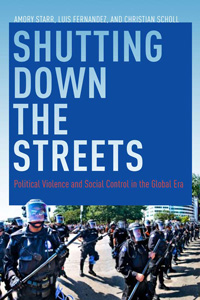
Amory Starr Luis A. Fernandez Christian Scholl 2011: New York University Press Don’t mind the press’ stupid title, the proper one is: Out of Order: The Political Violence of Social Control in the Era of Global Governance New York University Press ISBN: 9780814741009 September 2011  Recently, a wall was built in eastern Germany. Made of steel and cement blocks, topped with razor barbed wire, and reinforced with video monitors and movement sensors, this wall was not put up to protect a prison or a military base, but rather to guard a three-day meeting of the finance ministers of the Group of Eight (G8). The wall manifested a level of security that is increasingly commonplace at meetings regarding the global economy. The authors of Shutting Down the Streets have directly observed and participated in more than 20 mass actions against global in North America and Europe, beginning with the watershed 1999 WTO meetings in Seattle and including the 2007 G8 protests in Heiligendamm. Shutting Down the Streets is the first book to conceptualize the social control of dissent in the era of alterglobalization. Based on direct observation of more than 20 global summits, the book demonstrates that social control is not

How privatization works

At the pretty University I sometimes walk through, I pass one of the campus’ three gyms, noticing its advertising for membership. I’ve heard students describing the membership system to friends. A “gold” membership gets you into all three gyms, while a “bronze” membership only gets you one of them… I suppose the students who don’t like to exercise are glad they don’t have to subsidize the muscle-heads. Who wants to pay for a service they never use? I suspect student fees have not noticeably declined with the introduction of such policies. And public health advocates might argue that this system increases the activation energy required for preventative healthcare. In essence these policies privatize social budgets. What I mean by that is that instead of collective pools of money being allocated through a collective, ideological political process, money is allocated through private decision-making. And while some might argue (and I might actually agree) that the consumer-as-citizen exercises more power than the voter, our choices are not as free as they seem. When telephone and television were essentially public utilities, they were ubiquitous and cheap. Now that they are privatized, they are, to be sure, more “feature-rich”, and more expensive. The industries

Information isn’t what it used to be

I grew up on the phone. My mom, a sole proprietor, expected me to help with whatever was on. The San Francisco phone book was nearly 10cm thick and I knew how to use it. “I need 8 dozen beeswax candles and the color has to match.” Yellow pages. Candles. Rotary dial. I called every candle store in the Bay Area. They all answered the phone. Handed my mom a report 45 minutes later with prices and opening hours. “Great. Now call Jimmy’s on 7th and find out if they have coleslaw today.” White pages… The information age and the internet promise us perfect information. But they don’t deliver, and they beguile us with the illusion that we know when we don’t. The internet works ok to organize the coleslaw call. If I already know that something exists and have adequate information about it, I can usually find it. But if I didn’t know, for example, that Jimmy’s was on 7th , or didn’t think to add “barbecue” to my search, I’d be hunting through pages of Jimmy’s. Interrupting Mom with “I can’t find it” was not recommended. But the internet is a disaster for the candle project. Back in

4 years on Fantasy Island – $50-$100K

I haven’t been on a university campus in a long time. But I just moved near one, and my daily rounds often take it across it. I have been noticing the faces of the students. I see two things. One a reminder of why I avoid these places. The other a reminder of something else. First I see their suffering… Just waiting for the semester to be over, gotta take that stupid exam…I just want to get outta here! Institutionally structured (I believe) to miss entirely the incredible opportunities they have as students, not only relative to the 93% of the world’s population who will not spend time at University, but relative to their own likely future. Very few will continue to have access to scientific research journals, casual conversations with experts in any field, and sober, focused intellectual conversations with diverse peers. But this I knew. And students’ inability to engage with what is at hand in University, because they are too consumed with and annoyed by the irrelevant demands of the core curriculum check-sheet, because they have to work too many hours off campus to have time to do their coursework, because really  University is not an age-appropriate

Essay from the future

As usual there was a righteous hubbub when the terms of service changed. And as usual both the analysts and those who routinely trivialized their concerns went right on using their accounts. In truth both believed that the expression of outrage was a mix of self-satisfied geek intellectualism and effective boundary patrol by “the user community”.  This time they were wrong. Maybe they’d been wrong every time. We’ll never know. The wall posts were carefully composed, factual not slanderous. But always devastating. Expired permits, illicit substance arrests, drunk driving, tax fraud, sexual assault, child support and alimony arrears, traffic violation and crash records. No one had anything to hide on Facebook, except the things that are easy to hide, the things that are only between you and the government, who politely sends you letters in the mail. But it is these things which puncture the illusions at the troubled nexus of law and morality. In the States, the shock and shame caused 27,089 suicides in the first 24 hours, after which news media were forbidden to report them. The mortal impact in Western Europe was significantly less per capita, the myths of benign government and moral laws having a less

Wendy Neale, Maker

Interview by Tara Robertson in World Sweet World Issue #07 Original here: World Sweet World: Issue #07 67 STORY TIME: WENDY NEALE: MAKER She is a paradox; a designer who thinks there’s too much stuff in the world, and a professional furniture maker who has decided that she will no longer sell her pieces. She has a wicked sense of humour, punctuating our conversation with her trademark “I knoooow”. She is a curious explorer who likes to incorporate secret drawers or hidden features in her work. Here’s our conversation. How long have you been making furniture? I’ve been making furniture professionally for about 13 or 14 years. I started formally training in woodwork and jewellery making in 1996, however, I’ve been making furniture for a lot longer. About 15 years ago, my mum asked me to clean out a storage space with stuff from when I was a kid. I found my dolls, and all the balsa wood furniture that I had made for them. How long have you been doing craft? I was surrounded by people who were making things all the time, so I would say that I’ve always been a maker. My dad had a shed, and

Participatory Democracy in Action

Participatory democracy has been studied as an auxiliary to state processes and as an institutional and cultural part of social movements. This paper examines the use of participatory democracy as a form of organization of society. It examines three case studies: the Zapatistas (México), the Movimento Sem Terra (Brasil), and the Autonomen (Germany). This was the first paper in what was to be a larger project including the Venezuelan participatory processes and the Argentine empreses recuperadas and asambleas. It was inspired by the 2006 conference held to celebrate the work of Dick Flacks at his retirement. We were disappointed with the disinterest and incredulity that greeted the manuscript, and especially by Eric Olin Wright’s dismissal of any forms of participatory democracy independent of the state. This is an intermediate version of a paper eventually published in Latin American Perspectives, before they axed the lit review and the Germans.  

Baader-Meinhof Complex (film about the German Red Army Faction)

…The German government’s “official submission” to the Oscars… / “official story” of this period. On general principle, it’s probably not a good idea to go see movies generously funded by the state purporting to tell the history of anarchists. But it was a film festival…  (A friend has pointed out that since the German film industry is so small, almost all films receive some funding from the government.) But Badder-Meinhof Complex was the police name for this group, so that’s a very clear mark of who is telling the story here. I’m trying to understand the agenda and significance of the film. The story sticks close to wikipedia, and the review in Socialist Review doesn’t dispute anything.  Impressive handling of gender (more than one female main character!) But they left out the effectiveness of such actions. Another group, the Red Zoras, helped Korean labor movements to win struggles, through militant actions in Germany. (See George Katsiaficas, The Subversion of Politics: European Autonomous Social Movements and the Decolonization of Everyday Life). The film… buttresses the constructs “domestic terrorism” and “terrorists” (people who don’t even love their own children!)… Discourages radicalism (you’ll lose, suffer in jail, AND be confused)… Calls self-identified Marxist-Leninists

the political economy of food

I started teaching a course on this topic in 1995. At that time, the concept was so extremely uninteresting (both to the political economists and to the cultural studies people) that the university not only wouldn’t pay us but wouldn’t even allow us access to classroom space. Tony Samara and I taught the course in our living room for several years and I continued to teach it annually through 2009. The course has three topics:  production, trade, and consumption, or agroecology, economy, and consumer culture. Every semester we took the students on a field trip to the farmers market, and then home to teach them how to cook the things we’d fed them during the course, and also how to use the vegetables they’d brought home from the market. Many students from this class have gone on to become food activists. The Syllabus is below     This course was developed in 1995 and taught annually at 4 universities until 2009, which is the last time the syllabus was updated. all materials are provided for educational use only. Books: Christopher D. Cook, Diet for a Dead Planet. 2006: W W Norton & Co. C. Clare Hinrichs, Thomas A. Lyson, ed.,