Farmers in Action, Europe 2024
Farmers blockade highways, ports, and retailers in half the nations of the EU since 20.January. A French farmer explains why: https://amorystarr.com/farmers-in-action-europe-2024/







Farmers blockade highways, ports, and retailers in half the nations of the EU since 20.January. A French farmer explains why: https://amorystarr.com/farmers-in-action-europe-2024/


Our neighbor here in the countryside of France raises organic sheep. I asked him how much extra he earns for the organic label. He said he loses money because of it.

 You don’t need to charm your customers if you are sold out before the end of every market.
By the end of 2021 a great deal of unrelated material had been collapsed together in an attempt to discredit any and all points of view divergent from public health policy. Derogation and censorship have forced intimacy upon subcultures that might otherwise have remained separate. Thanks to the wholesale vilification of “vaccine hesitancy” pacifist alternative health movements find common cause with Trumpist militants and European neo-nazis. They deserve disaggregation.

I was enthusiastic to try Oxygen Builder, which allows designing your own post gallery in detail (in oxylingo, a “Repeater”). I was also hopeful to make the switch because Oxygen has lifetime pricing, while Elementor is a hefty annual payment. I worked for about 5 weeks, 3-8 hours a day with Oxygen on staging sites of 4 of my websites, replicating the more difficult parts of my Elementor designs. Here’s my full report.

What people are likely to do is what their friends are doing, and this is how the hipster movement has helped countless artisan roasters, brewers, bakers and bicycle-builders to build viable businesses.

A tableful of Italians are congratulating me for microfoam. I try to raise my voice above the clamor to explain that I would have made it before but I just didn’t understand why it would matter when you’re using cheap coffee and UHT milk. I’m learning that pride in appearances is more important than other qualities, including flavor. When I complain about not being able to speak at the table, the host writes to me: “A latte with coffee is different from a cappuccino, even though it is the same milk and the same coffee. Moreover, if it were not so, there would not be the cappuccino that the whole world loves and that the Italians have invented.” I spend the morning fuming about foam. In San Francisco, a ritual of childhood was visiting Freed Teller & Freed, where I pretended to enjoy the gift of a terribly bitter chocolate-covered bean while my mother’s weekly supply of freshly roasted oily “French Roast” beans were packed. This was long before the coffee revolution of micro-roasters and fresh beans swept the country. I didn’t find out about milk in coffee until I lived in New Zealand, where the milk is so delicious

After a month in the kitchen, I am still restricted to setting the table. Once I was allowed to stir something, but apparently that was a special situation. Foreigners are seen as culinary toddlers. If we knew what to do with tomatoes we wouldn’t be taking expensive holidays to Italy, now would we?

Success is a wage. Giving is a wage. And when these are denied, the cash is not enough.
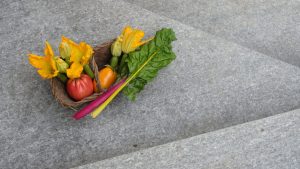
I brought zucchini directly from the farm. I had even picked it. Sunshine yellow, striped, and deep emerald. Too abundant in some places I’d lived, too expensive in others. I sliced them lovingly. We discussed the oven, settled on a skillet. I preemptively sloshed it with the good olive oil, then left him to induction jockey and turned to set the table. I appreciate home grown chilis, however hot. And I eat herbs like salad. But the bit of chili and the shower of cannistered herbes de provence displaced the delicate zucchini. My friend Nigel once deconstructed an unconvincing dinner party by explaining that our friends bought the cheapest ingredients they could find and then spent all day trying to add flavor to them. When I serve preposterously simple things to Italians I explain to them what “nouvelle” and “California” cuisine thinks it learned from the Mediterranean: to let the garden define cuisine, and do less to it in the kitchen. I can’t imagine anything more luxurious than eating within walking distance of a tomato patch. A bowl, a knife, balsamico, basil, oil, salt – all are nice, but not required. More than that strikes me as completely unnecessary. I
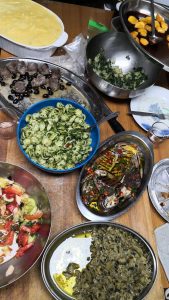
She turned from the table and walked back to the kitchen. It looked, as is to be expected at this point in the service, as if a landslide had passed through.
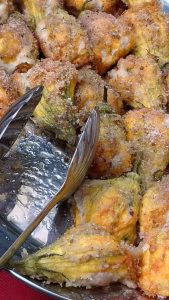
Valentina is 78 and almost always smiling. She is a workaholic. As her daughter takes the first bite of dinner, sitting down for the first time all day after serving 30 guests, Valentina is standing behind her chair and asks “what will we cook tomorrow?”
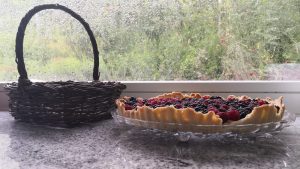
I planned an afternoon baking cookies with my friend. I wanted to bake small batches, adjusting the dough each time. By the end of this, she was irate: “It took too long!” “Oh, sorry, did you have something else to do?” “No, but I don’t want to stay in the kitchen any longer than necessary.” “Oh, I thought our plan was to hang out in the kitchen together?” Clearly my idea of “baking cookies” was socio-spatial, and hers was production oriented. We debriefed. She had raised three children. The kitchen had been a space of endless toil. I work long days on self-defined projects interwoven with shopping and snacking. For me the kitchen is a destination for contemplative munching, stirring, and assemblage, a sensual pause between tranches of production. I understand that people have different histories and emotions attached to different kinds of effort. What I don’t understand is what people want to finish laboring in order to do. Swipe through foodporn on instagram? Watch a cooking show on TV? As I travel through kitchens, I realize that most kitchens are not nice places to be. They are uncomfortable, overwhelmed with clutter, and defined by drudgery. So here’s a brief
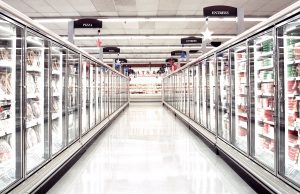
There is a lot to hate about supermarkets: how they treat farmers, deceptive pricing, seductive processed foods, degrading working conditions, chemical smells, and just plain ugliness. I’ve detailed these points with links to research and a guide to alternatives in my argument to criminalize. In Switzerland a supermarket duopoly dominate not only the food landscape, and sell gas, hardware, liquor, and banking. Riding high on Swiss exceptionalism, the locals have great faith and trust in these two 30Billion corporations. The faith is rooted in a benevolent history, reinforced by saturation advertising and . Both were legally structured as cooperative. Every Swiss resident is entitled to a free voting share of the Migros federation of businesses which is the largest employer in the country. No dividends are paid to shareholders, but 0.5% of the revenue is given to social and cultural projects. The founders’ philosophy is not legally binding on the company, but continue to provide a basis for faith: Adèle and Gottlieb Duttweiler also wrote their “fifteen theses” (1950) which, without being legally binding, are an ethical heritage of Migros. It contains values and guidance such as a goal of “serving the community”, “The general principle that we profess is
“I remember saying to somebody very early on that I just want to make furniture and talk to people about it. And I feel like now I might take the word ‘furniture’ out of it… The customers I’m thinking of can enunciate what they’re looking for in a piece of furniture beyond price. They have an experience in mind or a material connection or an aesthetic. Or they understood the slow movement and they liked the origin story.

As they have delivered work from labor and industrial logics, artisans have likewise redeemed materials from their status and calculus as “inputs”.

What I’ve learned from a year of pitching… So one question that comes to me is that if I’m going to have to do most of the promotion anyway, why would I give the publisher 85%? For what? The imprimatur of a “real” publisher? Let’s cut out the middlemen and the gatekeepers. And for me, the freedom to write what I want to, design the presentation, and launch it promptly is as important to my creative process as getting paid.
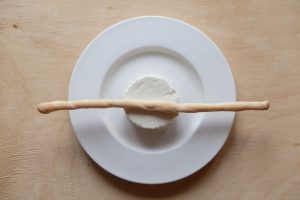
One surprise about living in Italy is that although I’m so close, I’m still so far. Many products that I first met in Boston, Los Angeles, Berlin, or Sydney, are not available outside of their region of origin. One of the few cheeses I could find in Berlin that I liked was a Pecorino Canestrato, from Sicily. Cannot get that here in the North. I love pane guttiau from Sardinia, but can only find unoiled pane carasau here (and generally quite low quality and stale at that). Burrata, a specialty of Apulia in the South, having become an international fad, is easier to find in Berlin than Turin. Piemonte is famous for two things that are not on my favorites list: truffles and hazelnuts. Its most famous cheeses, Castelmagno and Robiola are not especially to my liking either. In some of my travels I have followed gourmet guides by the letter, and was duly rewarded. In other cases the guides are just a starting point, after which I need to do my own exploring… By this method I have discovered here two foods that I have been waiting all my life for: Focaccia di Recco (from Liguria) and Zeppoline. The

People who are afraid that their governments withhold information are factually correct. People who are afraid that government programs might sacrifice certain categories of people in service of an undemocratic notion of “the public good” are validated by historic and recent events. People who are afraid that for-profit corporations could sell known harmful, addictive, or unsafe products have plenty of case data to underlie their concern.

Around the world is a crisis of modernization in which younger generations do not want to inherit the farming and other artisanal work of their families. At the same time, a subculture is burgeoning of young people and ex-office workers who want to work with land, agriculture, food, and traditional production methods.
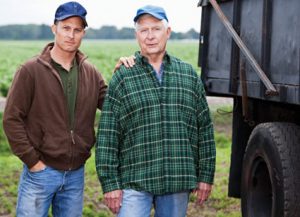
Around the world is a crisis of modernization in which younger generations do not want to inherit the farming and other artisanal work of their families. When farms and value-added productions are closed, we lose not only the quality, but also the knowledge of ecology, technique, tradition, and sustainable technology carried for generations. According to one study in the US, 2/3 of farms did not have a designated successor. In 2017, 92% of Canadian farms had no successor. At the same time, a subculture is burgeoning of young people and ex-office workers who want to work with land, agriculture, food, and traditional production methods. Continuity of productivity in the agricultural and artisan sectors not only affects the families involved, but also the economic health and vitality of rural communities and the landscape. It is urgent to support aging farmers and artisans by facilitating timely extra-familial succession of the land and business, and also importantly of their knowledge and skill. A database and facilitative services could reach farmers through local agricultural offices and business associations. Some farm organizations do offer resources, such as California FarmLink, and Canada’s Farmlink. In Europe, “the EU Common Agricultural Policy (CAP) executive proposed that a minimum

“It feels like now we’re competing with the entire finance industry… engaged in the process of trying to flip Wall Street… ”

What Italians do not seem to know is how profoundly revered Italian cuisine is in the US, and particularly in California. I could recognize my compatriots easily in Napoli. They were silent, faces upturned, eyes half-closed, eating the pizza as if they were receiving communion.

My anger is abating. I’m refocused on wondering how to buy as many good car bodies as possible and where to put them for a few years while the kits proliferate, mechanics streamline their methods, and countries improve their incentives.

Most of the R&D for our sustainable future was self-funded and unwaged. As part of our transition, we need to recognize the people who refused to be discouraged, who kept the possible viable.
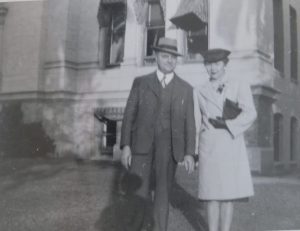
Shopping involved certain gestures, discreetly fingering the fabric, deftly flipping a garment open to see how it was sewn, to examine the quality of the lining. Objects were promptly upended to see the quality of workmanship and to search for manufacturers’ engravings. If she couldn’t lift and turn an object of interest with one hand, she’d give me the nod, and I would turn it upside down for her examination.

Impossible is the perimeter guard of the contemporary paradigm. We know that paradigms are generally under assault by research, adventure, invention, and culture, and that they are often superceded.

People who make guitars and surfboards, bread and pants, are driven by the pleasure of manifestation, the urge to work with their hands, and the need to work autonomously. Artists too, most artists, forego security and luxury in fealty to that same urgency. Filmmakers indebt themselves to the story that compels them. Not because it is a good investment. Farmers take second jobs so they can keep their land in production. I did not know that journalists who provide the food of democracy, also do this.
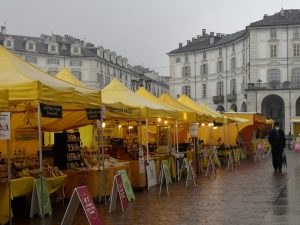
Just because I’m finally in Italy doesn’t mean I’m going to be able to get my favorite cheeses from Sicily and Campania (Southern Italy) any easier here in Turin (the Piemonte region is in the NorthWest of Italy) than in Berlin or Paris, because most of what’s on offer is going to be local.

As a philosopher, young Karl Marx learned that work was an aspect of being human. He became an economist in fury that work was being systematically torn from our personhood to serve industries. His intellectual and political inheritors have mostly sought to limit this incursion, to protect the person from the world of work. Which wasn’t quite the point. Meanwhile all around us people bolt because the work is even more important than the money.
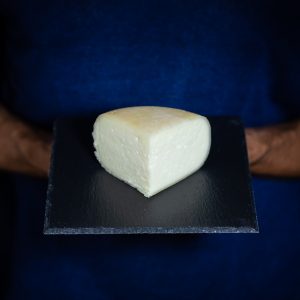
As a food tourist my strategy was simple: try lots of things and keep track of the names of the ones I like. Faced now with time to explore the diversity of Italy at leisure, I suddenly felt that I should be doing more than trawling for things I like. I should know why I like them.

There is no justification for the throughput of materials involved in junking cars less than 20 years old and encouraging people to buy new electric/hybrid. Even if the old car are purportedly “recycled”, metal recycling produces really terrible jobs. As does mining (often illegal) for e.g. cobalt and lithium needed for electric car batteries.
I marvel at Gorey’s wallpaper, Hopper’s shadows, Louis Comfort Tiffany’s colors, Al Hirschfeld’s space, Saul Steinberg’s simplicity, and Joel Rosenthal’s ability to make diamonds look like dust.

Greetings from Wailuki, Maui, Hawai’i. I am very fortunate to have been passing through Hawai’i when the travel restrictions went into effect, and to be welcomed to stay with friends, from whose house I can watch the whales snorting, sniffing the rain, flapping their tails, and jumping around everywhere. I am using this retreat to write a book about artisan economics and to reflect on how best I can be of service. I have some ideas… Today’s is to share my insights from 20 years of working at home on how to do that. It’s relevant both to folks who are doing their usual job at home and to those unable to work who are and are abruptly faced with the rather uncomfortable opportunity to move forward on your dream projects. With all the uncertainty we face, it’s even more important to spend our days with a sense of precious purpose. Especially in the current situation of global crisis, your most important productivity tip is to take time out from the apocalypse. In fact, this means taking time away from personal email and social media, because pretty much every conversation is going to spin it up again. I also hide

We cannot wait for or depend on government and experts to save us. The economy is made of our labor, intelligence, and skills. It belongs to us and we can and must take care of it.

29.November-5.February, 2020 [A prescript about photography:I felt very uncomfortable taking photos of people, as if zooifying their daily lives,and I was also uncertain about taking photos of spiritual acts and objects.Also … many of my photos were taken from the back of a motorcycle.My fastest camera being far slower than my perception,I often wished to have the implants of Greg Egan’s journalists of the future.] The first principle for the Balinese is the architecture and ritual of cosmology. The world is inhabited with gods and demons. They move in and out ofpeople and houses. The business of life is to get into good alignment with them. This structures the calendar, the day, the household, the community, and physical space. Temples pervade the landscape. Each one is 1.5 to 2m tall and 50cm-1.5 m wide. Many look old and worn, but these are not relics. They are in contemporary production. Some are entirely stone and some have an elaborately painted wooden section, featuring gold leaf. The wooden ones have a roof, wood or thatched, for protection. Stone temples make do with a satin umbrella for protection. Most of them wear two-layer skirts, a plain petticoat covered with a color+gold lame overskirt.
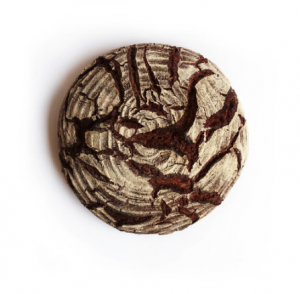
“Bread for us is an emotional product. How do we give it the level of attention it deserves? And how can we present bread in a different way? If we look at conventional bakeries, they stuff the bread on to one shelf. How do we make it a product you really desire, that triggers emotions and also reflect on traditional consumption and connect to bread in a different way?”

20 Years After Seattle: Call for Reflections by participants in N30 WTO manifestation.

Supermarkets are machines to betray farmers, consumers, and ecology. Farmers need reliable sales at the highest possible prices. Supermarkets buy whatever they can find at the cheapest possible price. This means they will buy foreign products before domestic ones if the price is lower. They also prefer large producers to avoid dealing with multiple suppliers to achieve the quantity they want to offer. This excludes smaller scale (often higher-quality) producers. The result of these purchasing decisions is to make small domestic farms financially unviable, eliminating domestic food security. Large monocrop farms are specialized and fragile systems, not easily redeployed in changing ecological and economic conditions. To maintain the illusion of cheapness and to ensure that their margins are high, supermarkets prefer low quality inexpensive products. They pressure producers to reduce quality to reduce price. Cheap products rely on cheap ingredients, with less nutritional value and less flavor. Large producers choose plant and animal varieties based on characteristics of rapid growth, standardization, and shelf life, not for flavor. And they produce meat and produce under unhealthy and unethical conditions that damage the ecology and put consumers at risk. Consumers also suffer from the promotion of unhealthy processed foods, which are

To be an ecological society we have to stop the whole habit of living despite nature. We must take our pleasure and inspiration in seasonality and ecological particularity.